FROM and Table References in SQL
By Owen Middleton · Updated September 2026 · Examples run on PostgreSQL 17
Builds toward WHERE Clause and Comparison Operators, ORDER BY and Result Sorting, DISTINCT, Aggregate Functions (COUNT, SUM, AVG, MIN, MAX)
What does the FROM clause do in SQL?
FROM is how you tell SQL which table to read from.
Without it, SELECT has nothing to work with. You can write arithmetic with just SELECT — quick calculations, labeled values — but the moment you need real data from the database, you need FROM to point SQL at the right place.
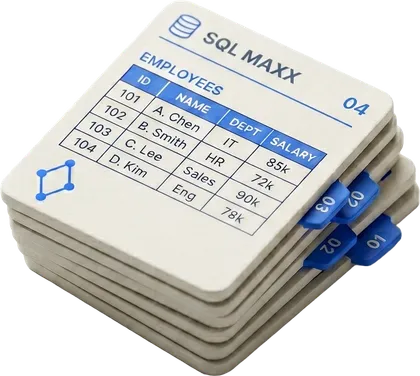
Think of a database like a filing cabinet where each drawer is a table. customers, products, orders — each one holds a different set of rows. FROM is you opening a specific drawer and telling SQL: start here. Every row in that drawer becomes available. SELECT then picks which columns to return.
How do you write a SELECT with FROM?
You'll use this pattern constantly as an analyst. A manager asks for a customer list. A stakeholder wants the product catalog. An ops person needs to see all recent orders. Every one of those starts the same way:
SELECT name, email
FROM customers
SQL reads the customers table and returns every row with two columns: name and email. Nothing else, regardless of how many other columns exist in the table.
Different table, completely different data:
SELECT id, name, price
FROM products
Change customers to products and you're in a different drawer entirely. The query structure is identical; the data is completely different.
What does SELECT * do in SQL?
When you're exploring a table for the first time, SELECT * returns every column at once. It's the fastest way to see what a table actually contains before you decide what you need.
What happens if you SELECT a column that does not exist?
One rule matters here: every column you name in SELECT has to exist in the table FROM points to. SQL checks this before running the query. Ask for a column that isn't there and you get an error immediately — not a blank result, not a null, an error.
You write SELECT phone FROM products, but the products table has no phone column. What happens?
Practice FROM Clause in SQL
Brightlane's merchandising team is building a master price list ahead of the Q4 catalog refresh.
Write a query to return every product's ID, name, and price.
Assumptions:
- The
productstable contains every item in Brightlane's catalog. - Each product has an
id, aname, and apricerecorded.
Output:
- One row per product, with columns
id,name, andprice.
Schema · ecommerce5 tables? = nullable
Run previews · Check grades
Write a query, then run it to see results here.
The full breakdown walks through the shape, each clause, why this approach beats the alternatives, and the trap to avoid.
See the full worked solution9 FROM Clause practice problems
Write a query to return every product's ID, name, and price.
Write a query to return the name and email of every customer.
Write a query to return the name and location of every department.
Write a query to return every order's ID, the ID of the customer who placed it, the timestamp it was placed, and its current status.
Write a query to return every employee's ID, name, job title, and hire date.
Write a query to return every registered user's ID, name, and current subscription plan.
Write a query to return every product category's ID and name.
Write a query to return every order line item with its record ID, the order it belongs to, the product ID, the quantity purchased, and the unit price at time of purchase.
Write a query to return every reporting period's numeric ID, display name, and the month numbers that define its start and end.
Start learning to practice all 9 FROM Clause problems, with instant grading and mastery tracking.
Common questions about FROM Clause
What happens if you select a column that is not in the table?
The query stops with column does not exist. PostgreSQL resolves every name in the SELECT list against the table FROM points at before it reads a single row, so a typo costs you an error rather than a blank column you might not notice.
Can a query run without a FROM clause?
Yes. A SELECT with no FROM evaluates its expressions and returns one row, which is how you check a calculation before pointing it at real data. You need FROM the moment you want values that live in a table.
How do you see every column in a table?
Select an asterisk instead of naming columns and PostgreSQL returns all of them. It is the fastest way to find out what a table actually holds before you decide which columns you need, which makes it an exploration tool rather than something to leave in a finished query.
What happens if the table name is wrong?
The query stops with relation does not exist, naming the table it could not find. PostgreSQL resolves table names before anything runs, so a misspelling gives you an error instead of an empty result you might mistake for a real answer.